
Stewartia / Stewartia henryae
Stewartia henryae 'Skyrocket' planted in early spring 2016, at the edge of the gravel garden.
From Broken Arrow Nursery. Supposed to be very narrow and tall, providing shade from the low afternoon western sun just where needed across the gravel sitting area.
Despite a dry summer, it looked good, and had decent fall color.
From Broken Arrow Nursery. Supposed to be very narrow and tall, providing shade from the low afternoon western sun just where needed across the gravel sitting area.
 |
| 5/20/16 |
Despite a dry summer, it looked good, and had decent fall color.
 |
| 10/30/16 |

Hedera helix / Adult Ivy
Planted 2 'Arborea' adult ivies in spring 2016 flanking the metal trellis in front of the garage wall.
This is a fascinating plant. I got a pair of 2-gallon plants at Broken Arrow Nursery. They should form big rounded mounds of glossy green foliage along the front walk.
Adult ivy is exactly what it sounds like -- the mature version of regular old English ivy.
When ivy reaches the top of whatever it is climbing and has nowhere further to go, it matures. The adult ivy changes genetically. The leaves lose their lobed points and become rounded. The vine stops being a vine and the topmost part of the plant becomes shrubby and dense.
If you take a cutting from the shrubby mature part of the ivy, it will keep its altered genetic characteristics -- you get another mature shrub form of the plant.
But if you plant the seeds from the mature flowering ivy, you get an immature vine, and you are back to having rampant vining English ivy with its distinctive three-lobed leaves.
This is a fascinating plant. I got a pair of 2-gallon plants at Broken Arrow Nursery. They should form big rounded mounds of glossy green foliage along the front walk.
Adult ivy is exactly what it sounds like -- the mature version of regular old English ivy.
 |
| at Wave Hill in October 2013 |
When ivy reaches the top of whatever it is climbing and has nowhere further to go, it matures. The adult ivy changes genetically. The leaves lose their lobed points and become rounded. The vine stops being a vine and the topmost part of the plant becomes shrubby and dense.
If you take a cutting from the shrubby mature part of the ivy, it will keep its altered genetic characteristics -- you get another mature shrub form of the plant.
But if you plant the seeds from the mature flowering ivy, you get an immature vine, and you are back to having rampant vining English ivy with its distinctive three-lobed leaves.
Cephalotaxus / Plum Yew
Planted Cephalotaxus harringtonia 'Korean Gold' in 2015 along the east wall of the house. It's from Forestfarm.
This plum yew will make a dense, upright evergreen form along the flat wall. It's perfect for tight spaces, and its bright color is eye catching. It forms an inverted pyramid, narrower at the base.
Here's an example of a larger, fuller one -- at maturity it will be 6 feet tall or more, but it's a real slow grower and will take some time to get there.

Louis the Plant Geek has some great culture information here on growing 'Korean Gold' plum yew.
 |
| 101/29/15 |
Here's an example of a larger, fuller one -- at maturity it will be 6 feet tall or more, but it's a real slow grower and will take some time to get there.

Louis the Plant Geek has some great culture information here on growing 'Korean Gold' plum yew.
Acer palmatum / Japanese maple 'Seiryu'
Planted in summer 2015, from Lowe's.
'Seiryu' is the only green dissected upright Japanese maple (not a weeper). It is planted in front of the dry creek bed, near the bridge. Should become a small upright tree.
'Seiryu' is the only green dissected upright Japanese maple (not a weeper). It is planted in front of the dry creek bed, near the bridge. Should become a small upright tree.
 |
| 6/20/15 |
 |
| 7/3/15 |
Ornithogalum / Star of Bethlehem
Star of Bethlehem
In 2014 I planted 50 Ornithogalum magnum bulbs to spread around all of the gardens for early summer white frilliness. They are from John Scheepers.
They can be invasive, but based on my experience with equally rampant spreaders like evening primrose, I am skeptical that these will get out of control.
 |
| 6/7/15 |
They add a bright white vertical in the somewhat chaotic early summer garden. Kind of like white candelabras!
 |
| 6/10/15 |
Spigelia / Indian Pink
Spigelia marilandica
Over the years I have tried to grow Indian pinks without success. I saw such a pretty stand at Garden in the Woods in Massachusetts, and big groups of them at Chanticleer.
A few were planted on 2015 at the front of the garden under the master bedroom window, but it's been hard to keep them going.
They need shade and moisture.
There is good profile of Spigelia marilandica here.
Over the years I have tried to grow Indian pinks without success. I saw such a pretty stand at Garden in the Woods in Massachusetts, and big groups of them at Chanticleer.
 |
| 6/27/13 at Chanticleer - not mine, I can't get a stand going |
A few were planted on 2015 at the front of the garden under the master bedroom window, but it's been hard to keep them going.
 |
| 6/15/13 |
%2B-%2B2013-06-21%2Bat%2B19-04-09.jpg) |
| 6/21/14 |
 |
| 5/30/15 |
They need shade and moisture.
There is good profile of Spigelia marilandica here.
Ageratina / White Snakeroot
 |
| 6/26/2011 just after transplant |
'Chocolate'
I think this is an Ex-Plant now. I didn't see it in 2015.
This used to be called Chocolate Joe Pye Weed and was in the Eupatorium class, but it is now Ageratina, white snakeroot.
When it is even slightly dry or in the heat of afternoon it wilts, but immediately perks up with some water.
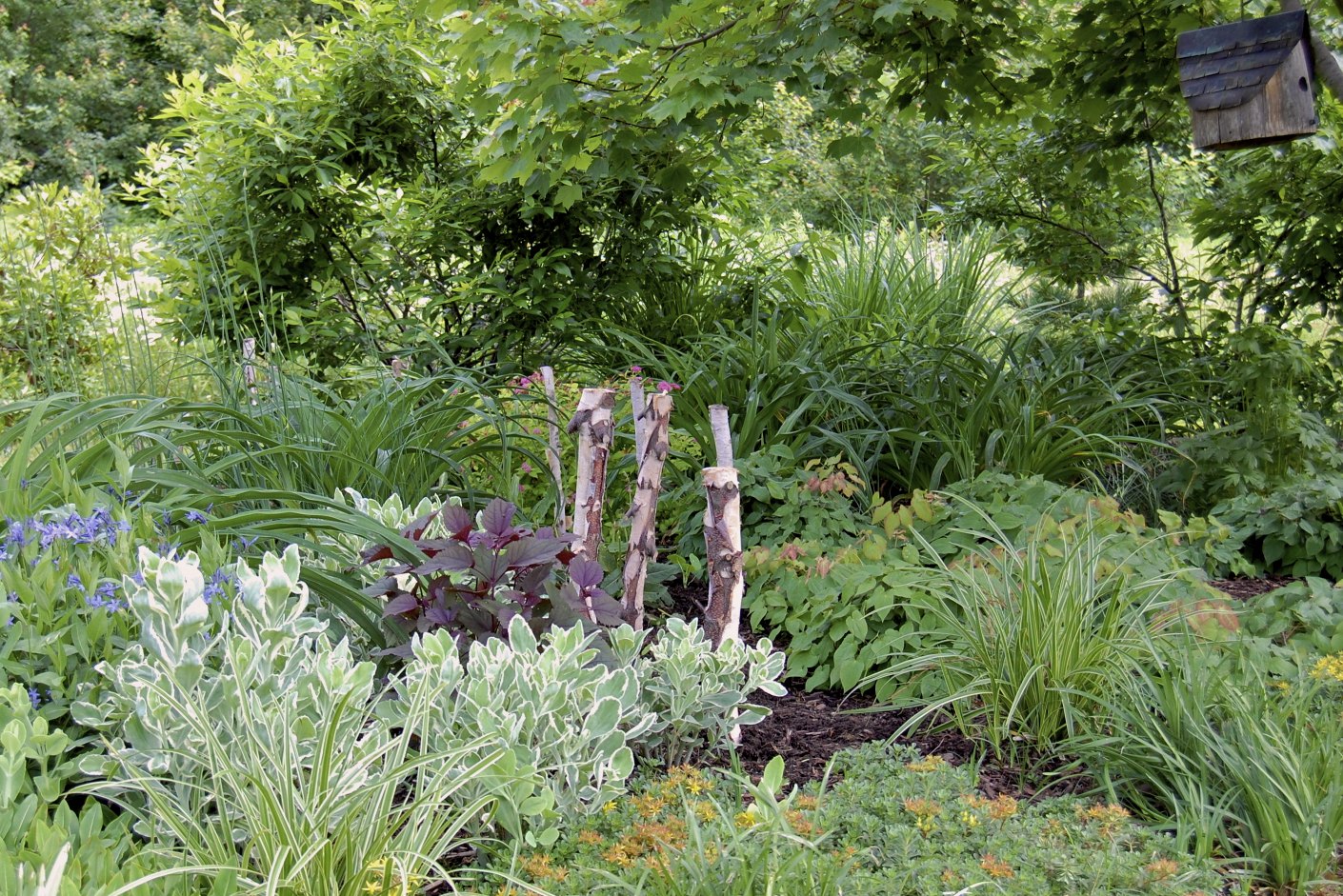
It is supposed to be sturdy and compact, and the deep dark foliage color really stands out. It's nice upright shape.
 |
| September 28, 2011 in bloom |
 |
| June 5, 2012 just peeking above the Frosty Morn sedums |
 |
| June 16, 2012 A nice foliage contrast |
In 2012 I don't remember the pretty white flowers late in the season. This plant may have been eaten or struggled in the hot dry summer; in any event, it was not visible in the garden after late June.
Once again, in 2013 this white snakeroot did nothing. Its dark foliage peeked up in spring, but then it just disappeared in summer, and there were no white flowers like I had seen in 2011.
 |
| June 1, 2013. Barely there next to the blue flowering amsonia |
In 2014 I never saw 'Chocolate'.
Chicago Botanic Garden has a great comparison here of Joe Pye Weeds, including 'Chocolate', now classified as Ageratina. They state that the Ageratina altissima plants in general succumbed over several winters, but that 'Chocolate' was a great performer. They do mention the tendency to wilt in summer and that they did not do as well in hot dry locations.
Is my 'Chocolate' too dry competing with the maple roots?
Betula lenta / Sweet Birch
I have tried for years to get sweet birch to grow on the back hill in the area I am reforesting. I got several small container saplings from Forestfarm in 2007 but none of them made it.
The other one is at the base of the hill, near the sassafras saplings. It too is slender and twiggy so far.
Sweet birch has shiny bark with horizontal lenticels that make it look like a cherry tree. Sometimes this is called cherry birch.

2015: continuing to have trouble getting sweet birch to grow for me. The one twiggy sapling that is at the edge of the back hill is doing okay.
But the little twig in the meadow gave up.
I may never get to see a large, mature sweet birch.
I tried again in 2013 with three little saplings from Forestfarm. Two survived the first year, but in 2014 I had to move one from a shady location under the maples on the hill out into the sunnier meadow.
It is open and slender from being in too much shade. It seemed to like its new space better and got a little leafier by the end of summer.
 |
| 9/24/14 |
The other one is at the base of the hill, near the sassafras saplings. It too is slender and twiggy so far.
Sweet birch has shiny bark with horizontal lenticels that make it look like a cherry tree. Sometimes this is called cherry birch.
The inner bark of twigs is supposed to taste of wintergreen. And birch beer is made from the sap of tapped sweet birches in spring.
2015: continuing to have trouble getting sweet birch to grow for me. The one twiggy sapling that is at the edge of the back hill is doing okay.
 |
| 7/3/15 |
But the little twig in the meadow gave up.
 |
| 7/8/15 |
I may never get to see a large, mature sweet birch.
Illicium parviflorum / Anise Tree
 I had such hopes -- but this is an Ex-Plant now. It did not survive winter in its container on the porch. Here's my brief experience:
I got a 'Florida Sunshine' anise plant from Wayside Gardens in 2014.
The foliage is supposed to smell like anise when crushed.
It is a bright chartreuse yellow leaved cultivar that remains evergreen, so it makes a lovely cheerful sight in the winter garden.
In full sun (with moisture) it will be yellower and fuller, and in shade looser and darker green.
Debs Garden has a nice profile of this plant.
The problem is that it is not hardy here. It is a southern plant, really zone 7, and the only way it works for me is in a pot.
So I have it in a container, and it is on the porch, protected. That doesn't fulfill its purpose to brighten the winter garden with lovely broadleaf evergreen foliage.
But I could not resist the allure of anise scent. "Illicium" means allurement in Latin -- really!
It wants moist shade. The best I can do is put the pot out in summer under the maple tree in Meadow's Edge, where in summertime it can brighten the dark recesses of that garden.
It can grow to 10 feet or more, it grows upright and conical with little pruning. It will form a suckering colony, but in a container that won't happen, and the size will be much less. But I am hoping I get a big, full, leafy plant.
Note
This is not star anise (Illicium verum), so it's not culinary. And it is not the stinky-flowered anise shrub (Illicium floridanum), which smells awful when blooming.
Rhus typhina / Staghorn Sumac
Staghorn sumac grows as a weed around here, and it was one of the first to move in where the earth had been disturbed on the back hill. At first I disliked it -- it looks so primitive with its compound frond-like leaves.
But I have grown to admire it as a pretty tree and an unusual look in the woods. It does spread about, and will form large stands unless I take out seedlings. I am starting to leave some of the new saplings along the edge of the meadow -- as they lean out at the edge of the lawn they are kind of nice.
They bloom in June. Later these cones of flowers turn dark red and hang on in winter.
They have beautiful fall color and are the first to turn red, showing off among the trees that are still green in September.
The trunks are slender and the trees lean gracefully. The leaves really are incredible. Check out the Oriental bittersweet vine growing on the trunks -- it's such a jungle on the back hill.


I don't have Rhus typhina in my garden, just the wild ones in the meadow and on the back hill. There are cultivars that are garden worthy, but I don't grow those.
At Wave Hill Garden in the Bronx they had an artfully pruned Staghorn sumac in the garden, and it really showed off the interesting look of the trunks as they age.

But I have grown to admire it as a pretty tree and an unusual look in the woods. It does spread about, and will form large stands unless I take out seedlings. I am starting to leave some of the new saplings along the edge of the meadow -- as they lean out at the edge of the lawn they are kind of nice.
They bloom in June. Later these cones of flowers turn dark red and hang on in winter.
 |
| 6/19/14 |
They have beautiful fall color and are the first to turn red, showing off among the trees that are still green in September.
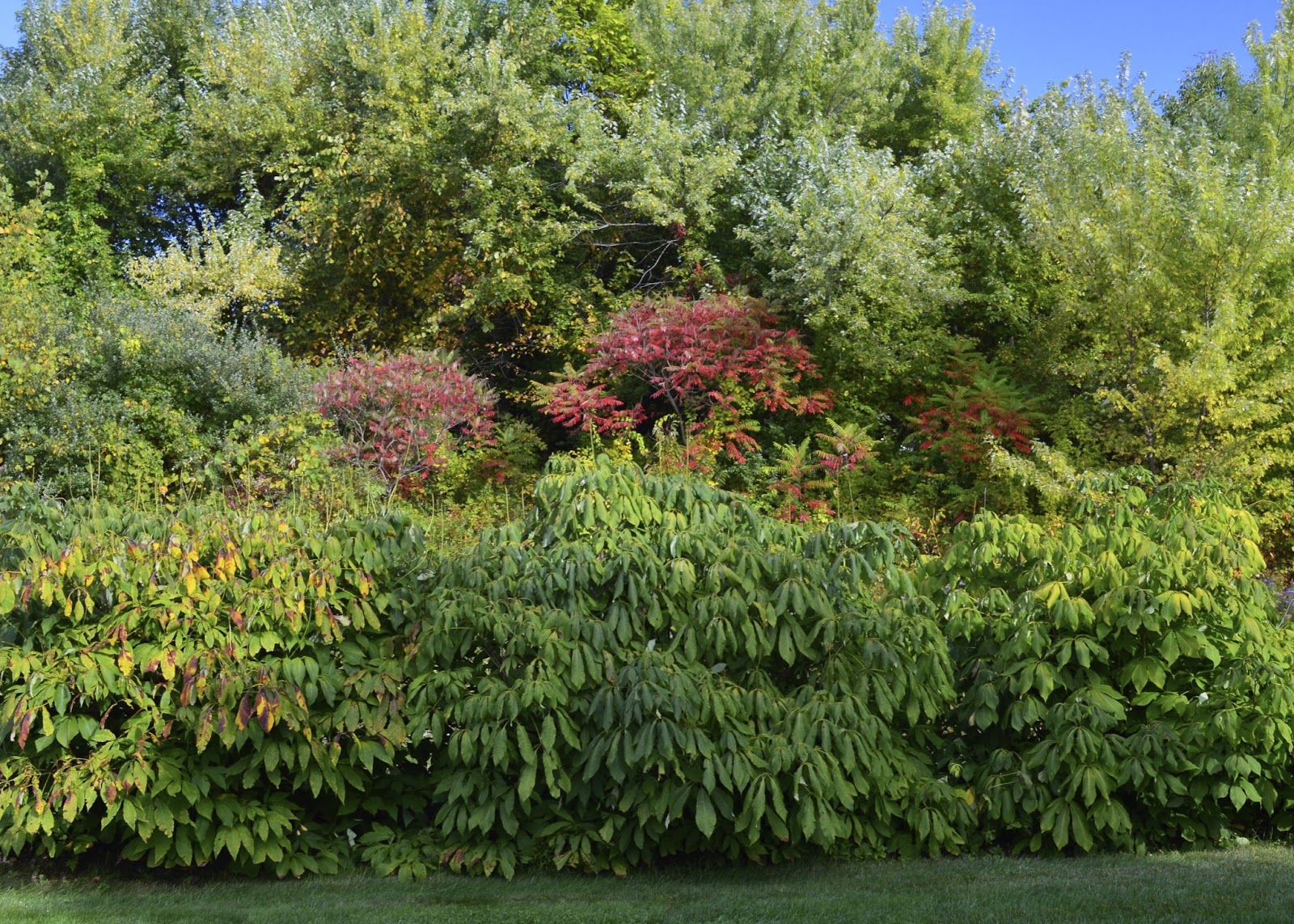 |
| 9/24/14 |
The trunks are slender and the trees lean gracefully. The leaves really are incredible. Check out the Oriental bittersweet vine growing on the trunks -- it's such a jungle on the back hill.
I don't have Rhus typhina in my garden, just the wild ones in the meadow and on the back hill. There are cultivars that are garden worthy, but I don't grow those.
At Wave Hill Garden in the Bronx they had an artfully pruned Staghorn sumac in the garden, and it really showed off the interesting look of the trunks as they age.
Abies Koreana / Korean Fir
 |
| 6/18/14 |
It was from Kevin's nursery before he closed. He told me he had propagated this himself, and because the parent plant was a mounder rather than a taller specimen he says my plant is likely to have a lower profile and stay rounded.
We'll see in 20 years.
All the pictures of mature ones show very pyramidal, structural trees.
Here is an example of what a 'Silberlocke' Korean fir will look like in maturity -- but if mine is more of a mounder as Kevin predicts, it won't be this shape or height at all.

Ostrya virginiana / Hophornbeam
 I got a 5 gallon American hophornbeam from Forestfarm in 2013 and planted it in the meadow behind the berm.
I had seen a mature one in 2011 in flower at the reservoir in West Hartford, and the pale tan flowers look a lot like hops.
It's a big, leafy, green forest tree, with these pretty little hop-like flowers in late June.
It will one day fill the gap between the last two spruces on the left of the berm, offering some screening from the road in back, filling the visual space between the spruces there.
 |
| 2011 - a hophornbeam in flower at the reservoir |
In 2014 I watered it a lot during the very dry summer, and it grew well. Here's a close up of the flowers (mine is still too young to flower):

My little hophornbeam is still a stick out in the meadow, but how it lights up at times!
 |
| 5/10/15 |
In early August I found a beautiful spider web hanging from the hophornbeam's little branches.
 |
| 8/9/15 |
 |
| 6/2/16 |

Hydrangea quercifolia / Oakleaf Hydrangea
Planted oakleaf hydrangea 'Amethyst' in the driveway garden in 2011. It was a tiny quart plant from Lazy S. 'Amethyst' is supposed to be a smaller oakleaf hydrangea, but I think that still means a 5 or 6 foot shrub. Its flowers are described as emerging white, but then turning deep wine red -- haven't seen it flower yet.
** I may have lost it in 2016 -- it declined and I had to cut it back to the ground. We'll see if anything comes up in 2017. ** note: it didn't really appear in 2017. I think it's gone.
I moved it around a couple times to find the right spot, and it finally wound up between the sweetgum and ninebark at the center of the bed along the driveway.
The leaves start to color up in mid October.
By late November this plant is the only color left in the brown, bare garden, and what an intense, rich color! Such a deep wine red. Its big leaves had been blown about by the wind, but it was one of the last to lose its foliage.
** I may have lost it in 2016 -- it declined and I had to cut it back to the ground. We'll see if anything comes up in 2017. ** note: it didn't really appear in 2017. I think it's gone.
 |
| 10/23/13 |
 |
| 8/7/15 |
By late November this plant is the only color left in the brown, bare garden, and what an intense, rich color! Such a deep wine red. Its big leaves had been blown about by the wind, but it was one of the last to lose its foliage.
 |
| 11/21/15 - Beautiful rich fall color |
Carpinus caroliniana / Blue Beech
 Planted behind the Birch garden, at the end of the strip of daylilies in spring 2013 from the Northwest Conservation District sale.
A pretty tree, with smooth gray bark that is sinewy and muscular looking. It's called American hornbeam. The wood is very hard.
This tree will stay small, up to about 20 feet tall, with a globular shape. Right now as a small sapling it is shaggy looking.
A surprise was the fall color, a clear, bright red. Needs no care.
Pycnanthemum muticum / Mountain Mint
Pycnanthemum muticum
I got these at the spring North Central Conservation District sale in 2014.
Planted this at the back of the driveway garden. There had been an empty spot behind the witch hazel, and I wanted something light to break up the density of the 'Summer Wine' deep purple ninebark nearby.
They immediately started filling in and forming a small upright stand of silvery foliage. These spread! They are bee magnets in bloom.
I got these at the spring North Central Conservation District sale in 2014.
Planted this at the back of the driveway garden. There had been an empty spot behind the witch hazel, and I wanted something light to break up the density of the 'Summer Wine' deep purple ninebark nearby.
 |
| 10/21/14 |
They immediately started filling in and forming a small upright stand of silvery foliage. These spread! They are bee magnets in bloom.
 |
| 8/6/15 |
 |
| 8/24/15 |
Alchemilla mollis / Lady's Mantle
Alchemilla
mollis
In spring 2013 I planted several Lady's mantle plants along the west walk. They will make a nice filler at the foot of the blackhaw viburnum. I added a few to the strip in front of the back garden too.
The effect is light and yellow and it brightens this dark part of the walkway.
mollis
In spring 2013 I planted several Lady's mantle plants along the west walk. They will make a nice filler at the foot of the blackhaw viburnum. I added a few to the strip in front of the back garden too.
The effect is light and yellow and it brightens this dark part of the walkway.
 |
| 5/22/15 |
 |
| 5/20/16 |
Mukdenia rossii
 |
| 8/3/13 |
'Crimson Fans'
These pretty plants have no common name other than mukdenia. It used to be classed as Aceriphyllum.
I put in several in fall of 2011, right at the entrance to the gavel garden from the bluestone walkway, but they were tiny and barely visible as winter arrived.
Here is a picture of the beautiful wine-tipped leaves that I saw at Cornell Plantations. The plants formed good sized low mounds and the foliage spilled over itself. The leaves are broad and glossy.
I put in six little plants to edge the gravel garden, shaded by other plants. It wants shade and moisture and may not like hot humid summers.
In early spring (April) there are tiny white starry flowers, but I haven't see those yet.
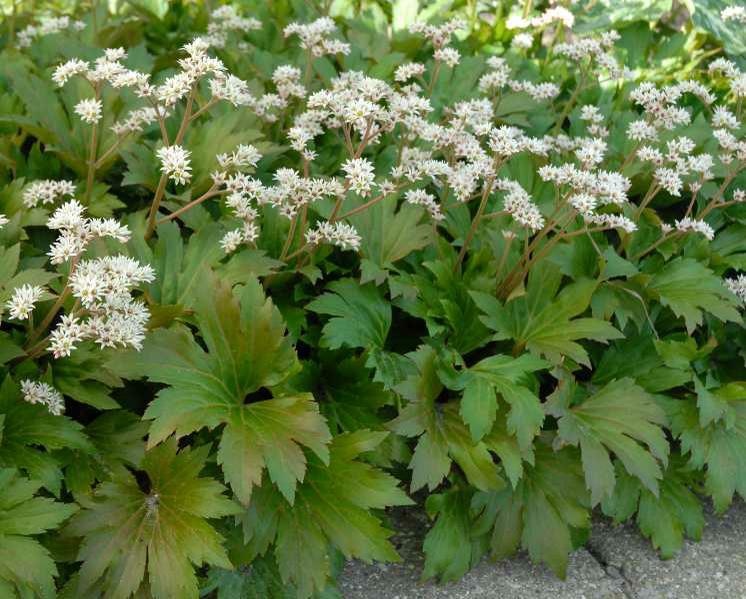 |
| picture from MoBot |
I'm trying to establish a small row spilling over the edges of the gravel garden. These are either taking their time to establish, or they don't like where I have put them.
 |
| 7/10/14 |
They certainly are slow to establish.
 |
| 5/23/15 |
Some sources say this is a plant hardy only to zone 7, others say zone 4. That's a wide difference.

This is a plant profile on Garden Web that shows some nice photos of mukdenia, including using it in a container.
Subscribe to:
Posts (Atom)